


Page 18 - Griffin Gazette Fall 2015
P. 18
Tank Mixing Pesticides:

        Yea or Nay?

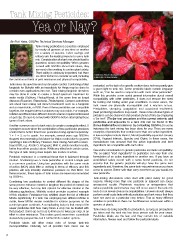
     By Rick Yates, GGSPro Technical Services Manager                               Geranium bloom damaged by
                                                                                    a tank mix of insecticides.
                                Tank mixing pesticides is a practice employed
                                by nearly all growers at one time or another       evaluated, so the lack of a specific caution does not necessarily give
                                for a variety of reasons. Labor savings and        a green light to tank mix. Some pesticide labels contain language
                                efficacy are the leading reasons to use a tank     such as, “can be used in conjunction with most other pesticides”.
                                mix. Consideration of a tank mix should lead to    While this provides some useful general information about overall
                                questions about compatibility. When growers        compatibility with other pesticides, it does not remove the need
                                 consult with GGSPro about tank mixes, they        for testing and trialing under your conditions. In some cases, the
                                 are most often seeking to confirm plant safety.   tank mixes are physically incompatible and a reaction occurs.
                                 Plant safety is obviously important, but there    Precipitates, clumping, coagulation and occasional exothermic
                                 are other factors to consider as well, including  (heat producing) reactions may result. These more obvious types of
    the continuous threat of pest resistance and physical compatibility.           problems can be observed and avoided ahead of time by employing
                                                                                   a “jar test”. (The jar test procedure and the correct order to add
    Tank mixes do save time and can broaden control. Combining a foliar            pesticides and adjuvants to a tank mix can be found in the
    fungicide for Botrytis with an insecticide for thrips may be done to           Bonus Material found online or by contacting GGSPro.) In some
    combine two applications into one. Tank mixing fungicide drenches              instances the tank mixing has been done for you. There are many
    may be done in order to create a broad-spectrum treatment for                  examples of pesticides that contain more than one active ingredient.
    water molds (Pythium, Phytophthora), at the same time as fungal                A few examples include Banrot, Mural (availability expected January
    diseases (Fusarium, Rhizoctonia, Thielaviopsis). Growers sometimes             2016), Pageant Intrinsic, Spectro and XXpire. In these cases, the
    ask about tank mixing soil drench treatments such as a fungicide               manufacturer has ensured that the active ingredients and inert
    and an insecticide, or PGR. Even if these pesticides are compatible            ingredients are compatible with each other.
    together, the required drench volumes may not match. For example,
    Citation and Bonzi have different drench volume requirements based             Give extra consideration to generic pesticides and tank compatibility.
    on pot size. Be sure to consult with GGSPro before attempting these            The so-called “inert ingredients” in pesticides can vary from one
    types of tank mixes.                                                           formulation of an active ingredient to another one. If you have an
                                                                                   established safety record with a name brand pesticide, do not
    Another common use of a tank mix is to create a synergistic effect. A          assume that the generic pesticide will also have the same inert
    synergism occurs when the combination of two pesticides produces               ingredients and, therefore, the same tank-mix performance you have
    control that is better than these pesticides being applied separately:         come to expect. Better safe than sorry; test them as you would any
    1 + 1 = 3, so to speak. For example, several years ago GGSPro                  new pesticide.
    stopped recommending Avid alone for thrips control due to growers
    reporting a loss of efficacy. However, tank-mixing Avid with a neem-           Tank-mixing discussions often start with plant safety for good
    based IGR, e.g. Azatin O, Azaguard, Molt-X, yields excellent results,          reasons. Mixing more than one pesticide or adjuvant can cause
    better than either product alone. While very effective in certain cases,       unexpected results. Phytotoxic reactions or antagonisms that
    this type of tank mixing does require two modes of action.                     reduce pesticide performance may still occur even if the tank mix
                                                                                   tests do not reveal obvious incompatibilities. Growers should always
    Pesticide resistance is a continual threat that is balanced through            perform small-scale trials with all pesticides and tank mixes that they
    rotation. Combining two or more pesticides to control a single pest            have not used on a particular crop before. Test as many different
    is a common practice. Using two pesticides with the same mode                  varieties as possible as there can be differences noted even within a
    of action (MOA) adds little or nothing in terms of efficacy, and this          species of plants.
    practice will only intensify resistance pressure on that MOA. For
    these reasons, these types of tank mixes are never recommended                 Tank mixes do bring benefits to production, as long as precautions
    by GGSPro.                                                                     are taken and the tank mix has been proven safe for your crops.
                                                                                   Pesticides labels are the law, and they contain lots of valuable
    Combining two pesticides to control different life stages of the               information. Always read and follow the pesticide labels.
    same pest to enhance control or lengthen the period of control can
    be very effective, but may limit options for effective rotation in the
    following applications. Whitefly control provides a perfect example
    of this situation: Resistance has whittled down the list of effective
    MOAs significantly. If a tank mix employing two different MOAs is
    made, fewer MOAs remain available for rotation purposes as the
    control program continues. A complicating factor is that many of the
    newer pesticides limit how many times a crop can be treated with
    that product. Some go so far as to limit use to twice per crop, in an
    effort to slow resistance. This makes good sense from a pesticide
    stewardship perspective, but it further limits rotation options.

    Pesticide labels will often make note of known tank-mix
    incompatibilities. Naturally, not all possible tank mixes can be

18

