


Page 107 - Griffin CEA Catalog- 2026-2027
P. 107
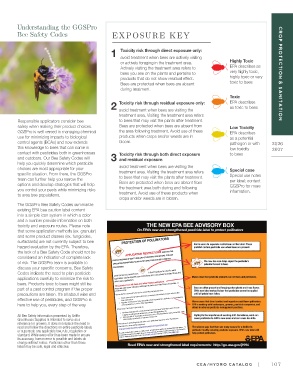
Understanding the GGSPro
        Bee Safety Codes                        EXPOSURE KEY


                                               1   Toxicity risk through direct exposure only:
                                                   avoid treatment when bees are actively visiting
                                                   or actively foraging in the treatment area.   Highly Toxic
                                                   Actively visiting the treatment area refers to   EPA describes as
                                                   bees you see on the plants and pertains to    very highly toxic,   CROP PROTECTION & SANITATION
                                                   products that do not show residual effect.    highly toxic or very
                                                   Bees are protected when bees are absent       toxic to bees
                                                   during treatment.
                                                                                                 Toxic
                                               2   Toxicity risk through residual exposure only:  EPA describes
                                                                                                 as toxic to bees
                                                   avoid treatment when bees are visiting the
                                                   treatment area. Visiting the treatment area refers
        Responsible applicators consider bee       to bees that may visit the plants after treatment.
        safety when making their product choices.   Bees are protected when bees are absent from   Low Toxicity
        GGSPro is well versed in managing chemical   the area following treatment. Avoid use of these   EPA describes
        use for minimizing impacts to biological   products when crops and/or weeds are in       as a potential
        control agents (BCAs) and now extends      bloom.                                        pathogen or with   2026
        this knowledge to bees that can come in                                                  low toxicity      2027
        contact with pesticides both in greenhouses   Toxicity risk through both direct exposure   to bees
        and outdoors. Our Bee Safety Codes will   3  and residual exposure:
        help you quickly determine which pesticide
        choices are most appropriate for your      avoid treatment when bees are visiting the    Special case
        specific situation. From there, the GGSPro   treatment area. Visiting the treatment area refers   Special use notes
        team can further help you narrow the       to bees that may visit the plants after treatment.   per label; contact
        options and develop strategies that will help   Bees are protected when bees are absent from   GGSPro for more
        you control your pests while minimizing risks   the treatment area both during and following   information.
        to area bee populations.                   treatment. Avoid use of these products when
                                                   crops and/or weeds are in bloom.
        The GGSPro Bee Safety Codes summarize
        existing EPA bee caution label content
        into a simple icon system in which a color
        and a number provide information on both
        toxicity and exposure routes. Please note
        that some application methods (ex. granular)
        and some product classes (ex. fungicides,
        surfactants) are not currently subject to bee
        hazard evaluation by the EPA. Therefore,
        the lack of a Bee Safety Code should not be
        considered an indication of complete lack
        of risk. The GGSPro team is available to
        discuss your specific concerns. Bee Safety
        Codes indicate the need to plan pesticide
        applications carefully to minimize the risk to
        bees. Products toxic to bees might still be
        part of a pest control program if the proper
        precautions are taken. It’s all about wise and
        effective use of pesticides, and GGSPro is
        here to help you, every step of the way.

        All Bee Safety information presented by Griffin
        Greenhouse Supplies is intended to serve as a
        reference for growers. It does not replace the need to
        read and follow the directions on entire pesticide labels
        or supersede any applicable law, rule, regulation or
        standard. While every effort has been made to ensure
        its accuracy, human error is possible and labels do
        change without notice. Pesticides other than those
        listed may be safe, legal and effective.


                                                                                   CEA/HYDRO CATALOG    |    107

