


Page 35 - Griffin Gazette - July 2026
P. 35
What Are Chelated Micronutrients?                     Plantex  Iron 6% EDDHA is top choice for high pH situations. Featuring
                                                                    ®
                                                              a strong ortho-ortho isomer, it provides exceptional stability up to pH 10,
        Chelated micronutrients consist of a micronutrient ion bound to an
                                                              ensuring reliable iron availability where uptake would typically be limited.
        organic molecule known as a chelator. This chelating agent surrounds
        the micronutrient in a stable structure that protects it from reacting with   Both products are easy to integrate into any fertility program and can
        other ions in the growing medium or nutrient solution.  either be applied to the soil as a drench or to the foliage as a fine spray.
                                                              For best results, mix thoroughly with water until fully dissolved.
        This protection prevents micronutrients from precipitating, oxidizing, or
        becoming immobilized — reactions that can occur when micronutrients
        are supplied in non-chelated forms. Chelation improves the stability and   Compatibility Risks When Mixing
        plant availability of micronutrients such as iron (Fe), manganese (Mn),   Sulphates and Chelates
        zinc (Zn), and copper (Cu).
                                                              Using sulphate micronutrients alongside chelated micronutrients can
                                                              introduce compatibility challenges. Free metal ions from sulphates —
        Why Chelated Micronutrients                           particularly copper, zinc, and manganese — can displace iron from its
        Are More Available Than Sulphates                     chelate. When this occurs, iron may precipitate and become unavailable
                                                              to plants.
        Sulphate micronutrients dissolve in water but exist as free metal
        ions once in solution. These ions can readily react with phosphates,   Depending on pH and solution conditions, this exchange can result in iron
        carbonates, or hydroxides, forming insoluble compounds that plants   losses of 20–50%, increasing the risk of iron deficiency. To reduce this
        cannot absorb. These reactions become more common as pH increases,   risk, chelated forms of manganese, zinc, and copper are recommended
        particularly above pH 6.0–6.5.                        whenever chelated iron is used.
        Chelated micronutrients remain protected from these reactions. The
                                                                        ®
        chelating agent keeps the micronutrient soluble and available across a   Plantex  NutriTrace CSM Fertilizer
        wider pH range maintaining consistent nutrient availability.
                                                              Plantex  NutriTrace CSM Fertilizer is a water-soluble fertilizer mix of
                                                                    ®
                                                              chelated secondary micronutrients which can be used as a preventative
        Iron: The Most Commonly                               supplement or as a corrective application where known deficiencies
        Chelated Micronutrient                                exist. By supplying micronutrients in a chelated form, growers reduce the
                                                              risk of precipitation and maintain availability of those nutrients for plant
        Iron is the micronutrient most frequently supplied in chelated form
                                                              uptake.
        because it is highly sensitive to pH and oxidation. As pH increases, iron
        readily converts into forms that are poorly available to plants, leading to
        deficiency symptoms even when total iron levels appear sufficient.  Key Takeaways
        Chelated iron protects iron from oxidation and precipitation, making it   Chelated micronutrients improve availability by protecting nutrients
        beneficial for greenhouse production, hydroponic systems, and high-pH   from precipitation and oxidation.  Plantex  Iron Chelates and Plantex
                                                                                           ®
                                                                                                               ®
        media.                                                NutriTrace CSM Fertilizer are key tools for greenhouse growers looking
                                                              to prevent deficiencies and manage micronutrients in their crops.  By
        Choosing the Right Iron Chelate                       incorporating these highly effective products into their nutrient programs,
        Based on pH                                           growers can ensure their plants have access to necessary nutrients for
                                                              healthy growth and optimal yields.
        Not all iron chelates perform equally. Chelate stability — and therefore
        iron availability — is strongly influenced by root-zone pH.


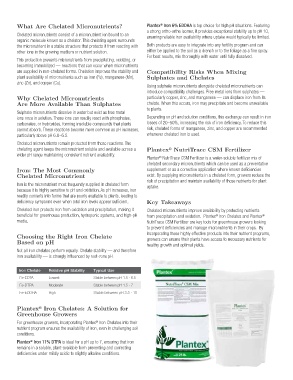
         Iron Chelate  Relative pH Stability  Typical Use
         Fe-EDTA     Lowest             Stable between pH 1.5 - 6.5
         Fe-DTPA     Moderate           Stable between pH 1.5 - 7
         Fe-EDDHA    High               Stable between pH 3.5 - 10

        Plantex  Iron Chelates: A Solution for
                 ®
        Greenhouse Growers

        For greenhouse growers, incorporating Plantex  Iron Chelates into their
                                         ®
        nutrient program ensures the availability of iron, even in challenging soil
        conditions.
        Plantex  Iron 11% DTPA is ideal for a pH up to 7, ensuring that iron
              ®
        remains in a soluble, plant-available form preventing and correcting
        deficiencies under mildly acidic to slightly alkaline conditions.

