


Page 15 - Griffin Gazette Issue 3 - 2019
P. 15
Plant and bloom safety are a strong suit for this class of chemistry. Mainspring GNL has been used widely by greenhouse and
            nursery growers on a large number of ornamentals over the past few years, yet GGSPro’s technical team has not received a
            single report of phytotoxicity to date. Diamide insecticides are broad spectrum with an impressive array of important insect
            pests on their labels. Add to that good compatibility for tank mixing. Bee safety is an important criterion when evaluating
            pesticides. In general, bee toxicity for this group of insecticides is short-lived, allowing growers to treat blooming crops safely
            when all label requirements are followed. Acelepryn has no bee cautions on the label.  More data is needed on the newer
            products, but compatibility with BCAs is promising. Add short re-entry intervals (REIs) into the equation and it is easy to see
            why the diamides are generating so much interest.


                                                                          Mode of
                                                         Active                             Drench (D)  Signal
                                           Trade names                     Action     REI
                                                         ingredient(s)                       Spray (S) Word
                                                                           (MOA)
                                           Acelepryn     Chlorantraniliprole  28      4        D,S     None
                                           Mainspring GNL  Cyantraniliprole  28       4        D,S     None

                                           Pradia        Cyclaniliprole,   28, 29     12        S      Caution
                                                         Flonicamid
                                           Sarisa        Cyclaniliprole     28        4         S      Caution
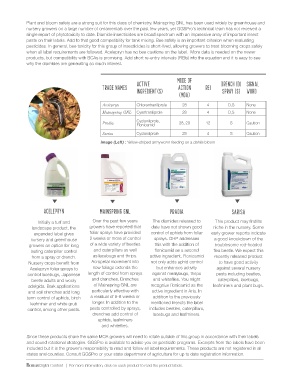
                                           Image (Left) : Yellow-striped armyworm feeding on a dahlia bloom


                   Acelepryn              Mainspring GNL               Pradia                    Sarisa

                 Initially a turf and    Over the past few years   The diamides released to   This product may find its
              landscape product, the   growers have reported that   date have not shown good   niche in the nursery. Some
               expanded label gives   foliar sprays have provided   control of aphids from foliar   early grower reports indicate
              nursery and greenhouse   2 weeks or more of control   sprays. OHP addresses   a good knockdown of the
             growers an option for long   of a wide variety of beetles   this with the addition of   troublesome red-headed
              lasting caterpillar control   and caterpillars as well   flonicamid as a second   flea beetle. We expect this
              from a spray or drench.   as lacebugs and thrips.   active ingredient. Flonicamid   recently released product
             Nursery crops benefit from   Acropetal movement into   not only adds aphid control   to have good activity
             Acelepryn foliar sprays to   new foliage extends the   but enhances activity   against several nursery
            control lacebugs, Japanese   length of control from sprays   against mealybugs, thrips   pests including beetles,
              beetle adults and wooly   and drenches. Drenches   and whiteflies. You might   caterpillars, lacebugs,
             adelgids. Bark applications   of Mainspring GNL are   recognize flonicamid as the   leafminers and plant bugs.
             and soil drenches add long   particularly effective with   active ingredient in Aria. In
            term control of aphids, birch   a residual of 6-8 weeks or   addition to the previously
              leafminer and white grub   longer. In addition to the   mentioned insects the label
            control, among other pests.  pests controlled by sprays,   includes beetles, caterpillars,
                                       drenches add control of   lacebugs and leafminers.
                                         aphids, leafminers
                                           and whiteflies.

            Since these products share the same MOA growers will need to rotate outside of this group in accordance with their labels
            and sound rotational strategies. GGSPro is available to advise you on pesticide programs. Excerpts from the labels have been
            included but it is the grower’s responsibility to read and follow all label requirements. These products are not registered in all
            states and counties. Consult GGSPro or your state department of agriculture for up to date registration information.


            Bonus  Digital Content   |  For more information, click on each product to read the product labels.

