


Page 19 - Griffin Gazette Issue 3 - 2019
P. 19
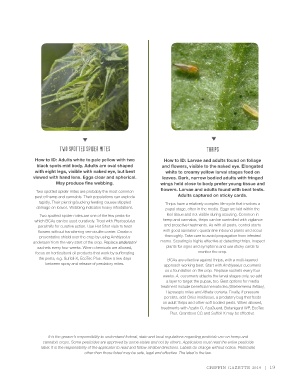
Two spotted spider mites                                    Thrips

                How to ID: Adults white to pale yellow with two      How to ID: Larvae and adults found on foliage
                black spots mid body. Adults are oval shaped        and flowers, visible to the naked eye. Elongated
               with eight legs, visible with naked eye, but best     white to creamy yellow larval stages feed on
               viewed with hand lens. Eggs clear and spherical.     leaves. Dark, narrow bodied adults with fringed
                        May produce fine webbing.                  wings held close to body prefer young tissue and

                Two spotted spider mites are probably the most common   flowers. Larvae and adults found with beat tests.
               pest of hemp and cannabis. Their populations can explode    Adults captured on sticky cards.
                 rapidly. Their piercing/sucking feeding causes stippled   Thrips have a relatively complex life-cycle that involves a
                damage on leaves. Webbing indicates heavy infestations.  pupal stage, often in the media. Eggs are laid within the
                 Two spotted spider mites are one of the few pests for   leaf tissue and not visible during scouting. Common in
               which BCAs can be used curatively. Treat with Phytoseiulus   hemp and cannabis, thrips can be controlled with vigilance
                 persimilis for curative action. Use Hot Shot vials to treat   and proactive treatments. As with all pests, control starts
                 flowers without transferring vermiculite carrier. Create a   with good sanitation: quarantine inbound plants and scout
                 preventative shield over the crop by using Amblyseius   thoroughly. Take care to avoid propagation from infested
               andersoni from the very start of the crop. Replace andersoni   moms. Scouting is highly effective at detecting thrips. Inspect
                 sachets every four weeks. When chemicals are allowed,   plants for signs and symptoms and use sticky cards to
                focus on horticultural oil products that work by suffocating       monitor the crop.
                 the pests, e.g. Suffoil-X, EcoTec Plus. Allow a few days   BCAs are effective against thrips, with a multi-layered
                    between spray and release of predatory mites.    approach working best. Start with Amblyseius cucumeris
                                                                     as a foundation on the crop. Replace sachets every four
                                                                    weeks. A. cucumeris attacks the larval stages only, so add
                                                                      a layer to target the pupae, too. Best options for media
                                                                   treatment include beneficial nematodes (Steinernema feltiae),
                                                                      Hypoaspis miles and Atheta coriaria. Finally, if pressure
                                                                     persists, add Orius insidiosus, a predatory bug that feeds
                                                                    on adult thrips and other soft bodied pests. When allowed,
                                                                    treatments with Azatin O, AzaGuard, Botanigard WP, EcoTec
                                                                       Plus, Grandevo CG and Suffoil-X may be effective.


                     It is the grower’s responsibility to understand federal, state and local regulations regarding pesticide use on hemp and
                   cannabis crops. Some pesticides are approved by some states and not by others. Applicators must read the entire pesticide
                  label. It is the responsibility of the applicator to read and follow all label directions. Labels do change without notice. Pesticides
                                    other than those listed may be safe, legal and effective. The label is the law.


                                                                                      GRIFFIN GAZETTE 2019  |  19

