


Page 23 - Griffin Gazette Issue 3 - 2019
P. 23
Nutrient deficiencies are best diagnosed with   Lower Rates
                      visual symptoms backed up by media and
                      tissue analysis at a reputable testing lab. Iron   As growers have become more efficient
                      deficiency is typically the micronutrient that   at using water soluble fertilizers, they have
                      growers focus on when they observe chlorosis   decreased the total amount they are routinely
                      or yellowing on new plant tissue, however   applying to reduce waste and save money.  As
                      similar symptoms can be caused by a shortage   concentrations drop below 150 ppm N; an
                      of other micronutrients such as manganese    unforeseen consequence of this efficiency is
                      or copper.                                 that the micronutrient supply can be insufficient.
                                                                 Adding a very small amount of Liquid STEM (3.5
                                                                 to 10 ml/ 100 gallons) to the stock tank
                      Micronutrient deficiencies seem to be more   on a constant basis will boost the
                      common these days.  I think this is due to   micronutrient supply.
                      several factors:
                       •  New crop genetics that are inefficient at
                         taking up micronutrients.               Water/ Media Quality
                       •  Growers using lower fertilizer concentrations
                         (ppm N) or rates that result in an inadequate   Maintaining a rootzone pH (5.5 to 6.5) is
                         micronutrient supply.                   the best way to guard against micronutrient
                                                                 deficiencies. Fertilizer selection is critical. It is
                       •  Issues with water quality – excess total   best to test your irrigation water first, then select
                         alkalinity or bicarbonates that increase root   a fertilizer based on active and potential acidity.
                         zone pHs.                               ICL can help growers work through this process
                       •  Issues with growing media components and   – contact your ICL Territory Manager for more
                         lime charges that lead to high root zone pH.  details. If water alkalinity is too high or lime
                                                                 charge is excessive, highly active fertilizers like
                                                                                                  ®
                                                                                           ®
                                                                           ®
                                                                 Peters Excel  and Peters Excel  pHLow  can
                      New Crops                                  reduce and maintain pH at acceptable levels.
                                                                 These fertilizers can prevent micronutrient
                                                                 deficiencies by attacking the underlying cause
                      A young plant supplier should be able to provide
                      guidance on any special nutrient requirements   (high pH).
                      of new crops added to a production schedule.
                      ICL has also developed several new water-  Rescue
                      soluble formulations such as Peters  20-3-19
                                                   ®
                      Petunia Special and Peters Professional    If rootzone pH has increased during production
                      15-3-25 Flowering Plant Special with black   and micronutrient deficiencies have developed,
                      Iron. These formulations contain elevated iron   a rescue treatment is quickly needed to keep a
                      employing HBED (aka black Iron), the strongest   crop salable. If uncertain of the cause, Peters
                                                                                                    ®
                      iron chelate on the market - efficacious at very   Liquid STEM is a great product to use as
                      high root zone pHs. These are very good fits for   it contains all the micronutrients required.
                      “iron-hungry” plants.
                                                                 Oftentimes a crop will be treated with a chelated
                      New plants with special nutrient requirements   iron source when the deficiency issue is caused
                      may conflict with the needs of other crops   by a lack of another micronutrient. In this
                      grown. These plants may need to be         situation, the symptom will not be reversed,
                      periodically treated with additional drenches of   and valuable time wasted. Treating with Peters
                                                                                                    ®
                                        ®
                      micronutrients.  Peters  Liquid Stem is a great   Liquid STEM will likely supply the micronutrient
                      product to use for this purpose at a rate of 4 to   needed to green up a crop without delay.
                      8 fl. oz. / 100 gallons. It will supply a complete   Another possible rescue is the use of Peters 21-
                      array of micronutrients in chelated form that   7-7 Acid Hammer – a few applications can boost
                      are highly soluble and compatible with virtually   iron levels and lower rootzone pH significantly.
                      every fertilizer and even most pesticides.
                                                                 For more details of the products mentioned
                                                                 above, go to: https://icl-sf.com/us-en/explore/
                                                                 ornamental-horticulture/


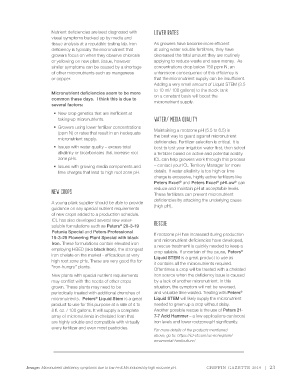
            Image: Micronutrient deficiency symptoms due to low Fe & Mn induced by high rootzone pH.  GRIFFIN GAZETTE 2019  |  23

