


Page 23 - Griffin Gazette Issue 2 - 2020
P. 23
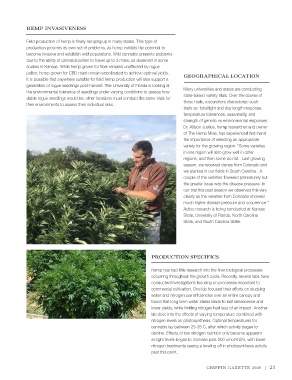
HEMP INVASIVENESS


            Field production of hemp is finally ramping up in many states. This type of
            production presents its own set of problems, as hemp exhibits the potential to
            become invasive and establish wild populations. Wild cannabis presents problems
            due to the ability of cannabis pollen to travel up to 3 miles, as observed in some
            studies in Kansas. While hemp grown for fiber remains unaffected by rogue
            pollen, hemp grown for CBD must remain unpollinated to achieve optimal yields.   GEOGRAPHICAL LOCATION
            It is possible that anywhere suitable for field hemp production will also support a
            generation of rogue seedlings post-harvest. The University of Florida is looking at
            the environmental tolerance of seedlings under varying conditions to assess how   Many universities and states are conducting
            viable rogue seedlings would be; other locations must conduct the same trials for   state-based variety trials. Over the course of
            their environments to assess their individual risks.             these trials, researchers characterize such
                                                                             traits as: total light and day length response,
                                                                             temperature tolerances, seasonality, and
                                                                             strength of genetic vs environmental responses.
                                                                             Dr. Allison Justice, hemp researcher and owner
                                                                             of The Hemp Mine, has experienced first-hand
                                                                             the importance of selecting an appropriate
                                                                             variety for the growing region. “Some varieties
                                                                             in one region will also grow well in other
                                                                             regions, and then some do not.  Last growing
                                                                             season, we received clones from Colorado and
                                                                             we planted in our fields in South Carolina.  A
                                                                             couple of the varieties flowered prematurely but
                                                                             the greater issue was the disease pressure. In
                                                                             our trial this past season we observed this very
                                                                             clearly as the varieties from Colorado showed
                                                                             much higher disease pressure and occurrence.”
                                                                             Active research is being conducted at Kansas
                                                                             State, University of Florida, North Carolina
                                                                             State, and South Carolina State.


                                                                PRODUCTION SPECIFICS


                                                               Hemp has had little research into the finer biological processes
                                                               occurring throughout the growth cycle. Recently, several labs have
                                                               conducted investigations focusing on processes important to
                                                               commercial cultivation. One lab focused their efforts on studying
                                                               water and nitrogen use efficiencies over an entire canopy and
                                                               found that long term water stress leads to leaf senescence and
                                                               lower yields, while limiting nitrogen had less of an impact. Another
                                                               lab dove into the effects of varying temperature combined with
                                                               nitrogen levels on photosynthesis. Optimal temperatures for
                                                               cannabis lay between 25-35 C, after which activity began to
                                                               decline. Effects of low nitrogen nutrition only became apparent
                                                               as light levels began to increase past 500 umol/m2/s, with lower
                                                               nitrogen treatments seeing a leveling off in photosynthesis activity
                                                               past this point.


                                                                                      GRIFFIN GAZETTE 2020  |  23

