


Page 21 - Griffin Gazette Issue 2 - 2020
P. 21
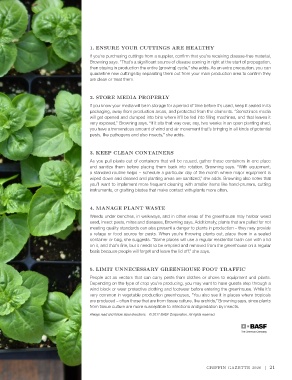
1. ENSURE YOUR CUTTINGS ARE HEALTHY

                                      If you’re purchasing cuttings from a supplier, confirm that you’re receiving disease-free material,
                                      Browning says. “That’s a significant source of disease coming in right at the start of propagation,
                                      then staying in production the entire [growing] cycle,” she adds. As an extra precaution, you can
                                      quarantine new cuttings by separating them out from your main production area to confirm they
                                      are clean or treat them.


                                      2. STORE MEDIA PROPERLY
                                      If you know your media will be in storage for a period of time before it’s used, keep it sealed in its
                                      packaging, away from production areas, and protected from the elements. “Sometimes media
                                      will get opened and dumped into bins where it’ll be fed into filling machines, and that leaves it
                                      very exposed,” Browning says. “If it sits that way over, say, two weeks in an open planting shed,
                                      you have a tremendous amount of wind and air movement that’s bringing in all kinds of potential
                                      pests, like pathogens and also insects,” she adds.


                                      3. KEEP CLEAN CONTAINERS

                                      As you pull plants out of containers that will be reused, gather those containers in one place
                                      and sanitize them before placing them back into rotation, Browning says. “With equipment,
                                      a standard routine helps – schedule a particular day of the month where major equipment is
                                      wiped down and cleaned and planting areas are sanitized,” she adds. Browning also notes that
                                      you’ll want to implement more frequent cleaning with smaller items like hand-pruners, cutting
                                      instruments, or grafting blades that make contact with plants more often.


                                      4. MANAGE PLANT WASTE
                                      Weeds under benches, in walkways, and in other areas of the greenhouse may harbor weed
                                      seed, insect pests, mites and diseases, Browning says. Additionally, plants that are pulled for not
                                      meeting quality standards can also present a danger to plants in production – they may provide
                                      a refuge or food source for pests. When you’re throwing plants out, place them in a sealed
                                      container or bag, she suggests. “Some places will use a regular residential trash can with a lid
                                      on it, and that’s fine, but it needs to be emptied and removed from the greenhouse on a regular
                                      basis because people will forget and leave the lid off,” she says.


                                      5. LIMIT UNNECESSARY GREENHOUSE FOOT TRAFFIC

                                      People act as vectors that can carry pests from clothes or shoes to equipment and plants.
                                      Depending on the type of crop you’re producing, you may want to have guests step through a
                                      wind block or wear protective clothing and footwear before entering the greenhouse. While it’s
                                      very common in vegetable production greenhouses, “You also see it in places where tropicals
                                      are produced – often those that are from tissue culture, like orchids,” Browning says, since plants
                                      from tissue culture are more susceptible to infections and predation by insects.
                                      Always read and follow label directions.   © 2017 BASF Corporation. All rights reserved.


                                                                                      GRIFFIN GAZETTE 2020  |  21

