


Page 21 - Griffin Gazette - March 2026
P. 21
Indoor  edible  and  medicinal  crop  production  is  all
                 about control. We control light levels, temperature, air
                 movement, CO , irrigation timing, and nutrition. That
                             2
                 level of control is what makes CEA so powerful. But it
                 also means one weak link can show up fast and spread
                 even faster. That weak link is often sanitation.
                 For indoor growers, cleanliness is not just about looking
                 professional. It is about protecting plant health, keeping
                 crops consistent, and avoiding the kind of problems
                 that force you to spend extra labor and money later. A
                 clean facility helps crops start stronger, finish cleaner,
                 and stay on schedule. One of the biggest reasons
                 sanitation matters in CEA is because everything is
                 close  together  and  often  connected.  Plants  sit  in
                 tight spacing, production zones share air and water
                 systems, and people move between rooms all day
                 long. In that environment, algae, plant pathogens, and
                 insects do not have to travel far to become a facility-
                 wide headache. Moreover, it can be difficult to isolate
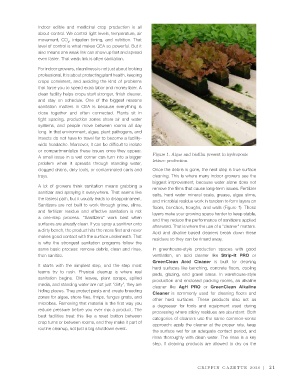
                 or compartmentalize these issues once they appear.   Figure 1. Algae and biofilm present in hydroponic
                 A small issue in a wet corner can turn into a bigger   lettuce production.
                 problem when it spreads through standing water,
                 clogged drains, dirty tools, or contaminated carts and   Once the debris is gone, the next step is true surface
                 trays.                                         cleaning. This is where many indoor growers see the
                                                                biggest improvement, because water alone does not
                 A lot of growers think sanitation means grabbing a
                                                                remove the films that cause long-term issues. Fertilizer
                 sanitizer and spraying it everywhere. That seems like
                                                                salts, hard water mineral scale, grease, algae slime,
                 the fastest path, but it usually leads to disappointment.
                                                                and microbial residue work in tandem to form layers on
                 Sanitizers are not built to work through grime, slime,
                                                                floors, benches, troughs, and walls (Figure 1). Those
                 and fertilizer residue and effective sanitation is not
                                                                layers make your growing space harder to keep stable,
                 a one-step process. “Sanitizers” work best when
                                                                and they reduce the performance of sanitizers applied
                 surfaces are already clean. If you spray a sanitizer onto
                                                                afterward. That is where the use of a “cleaner” matters.
                 a dirty bench, the product hits the mess first and never
                                                                Acid and alkaline based cleaners break down these
                 makes good contact with the surface underneath. That
                                                                residues so they can be rinsed away.
                 is why the strongest sanitation programs follow the
                 same basic process: remove debris, clean and rinse,   In greenhouse-style production spaces with good
                 then sanitize.                                 ventilation, an acid cleaner like  Strip-It PRO or
                                                                GreenClean Acid Cleaner  is built for cleaning
                 It starts with the simplest step, and the step most
                                                                hard surfaces like benching, concrete floors, cooling
                 teams try to rush. Physical cleanup is where real
                                                                pads,  glazing,  and  gravel areas. In  warehouse-style
                 sanitation begins. Old leaves, plant scraps, spilled
                                                                production and enclosed packing rooms, an alkaline
                 media, and standing water are not just “dirty”, they are
                                                                cleaner like AgH PRO or  GreenClean Alkaline
                 hiding places. They protect pests and create breeding
                                                                Cleaner  is commonly used for cleaning floors and
                 zones for algae, shore flies, thrips, fungus gnats, and
                                                                other hard surfaces. These products also act as
                 microbes. Removing that material is the first way you
                                                                a degreaser for tools and equipment used during
                 reduce pressure before you ever mix a product. The
                                                                processing where sticky residues are abundant. Both
                 best facilities treat this like a reset button between
                                                                categories of cleaners use the same common-sense
                 crop turns or between rooms, and they make it part of
                                                                approach: apply the cleaner at the proper rate, keep
                 routine cleanup, not just a big shutdown event.
                                                                the surface wet for an adequate contact period, and
                                                                rinse thoroughly with clean water. The rinse is a key
                                                                step.  If  cleaning  products  are  allowed  to  dry  on  the
                                                                                   GRIFFIN   GAZETTE  20 26 |   21

