


Page 15 - 2015 Spring Gazette
P. 15
Bonus

Botrytis DigitalContent
Cultural and Fungicide Control Options

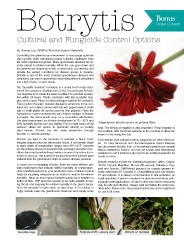
By Joanne Lutz, GGSPro Technical Support Specialist                   Image above: Botrytis spores on gerbera Daisy

Controlling the greenhouse environment to encourage optimum           heat. The timing of irrigation is also important. If drip irrigation is
plant growth while maintaining proper humidity challenges even        not available, limit overhead watering to the morning to allow the
the most experienced grower. Many greenhouse diseases are di-         leaves to dry during the day.
rectly related to relative humidity. When the sun goes down and
the greenhouse temperature falls, condensation can develop and        Even with the best cultural controls, fungicides are often still need-
provide the perfect conditions for disease spores to develop.         ed. Dr. Gary Moorman from the Pennsylvania State University
Botrytis is one of the most common greenhouse diseases and            has discovered Botrytis from a Pennsylvania greenhouse sample
symptoms can vary in appearance depending where it penetrates         that is resistant to Decree. It is not yet known how widespread
into a leaf, flower or stem tissue.                                   resistance is but it reinforces the need to be rotating fungicides by
                                                                      mode of action.
The "humidity chamber" technique is a useful tool to help deter-
mine if the symptoms displayed are, in fact, the pathogen Botrytis.   Botrytis rotations include the following fungicides: Affirm, Chipco
The objective is to create the ideal conditions to promote sporula-   26019, Daconil, Medallion, Mozart (TR aerosol), Palladium, Pag-
tion within 24 hours. Plastic containers with lids or plastic bag-    eant and Spectro. OMRI-listed products for organic growers in-
gies can be used. Place a moistened paper towel in the container.     clude Actinovate SP, Camelot O, Cease/Milstop tank mix Nordox
Then position the plant material displaying symptoms in the con-      75 and OxiDate. It is always recommended to trial pesticides on
tainer but not in direct contact with the wet paper towel. A bottle   small quantities of plants to evaluate for phytotoxicity before mak-
cap or small plastic lid can be used for this purpose. Place the      ing large scale applications. Products other than those mentioned
container in a warm environment out of direct sunlight. If Botrytis   may be safe and effective. Always read and follow the entire pes-
is present, the characteristic gray, fuzzy sporulation will develop.  ticide label. Please note, the products listed may not be registered
The ideal environment for Botrytis development is 75 – 82°F and       for use in all states.
80% humidity but this can vary slightly. Four to eight hours of leaf
wetness allows the spores to germinate directly on healthy
plant tissues. Botrytis can also make penetration through
wounds or natural openings.

Botrytis can lead to the formation of sclerotia, a black, hard,
irregular shaped structure within plant tissue. It can remain viable
in plant debris at temperature ranges from 39°-131°F. Sclerotia
are the primary means of survival for this pathogen and when con-
ditions become favorable they provide a source of inoculum for in-
fection to reoccur. This is why the prompt removal of infected plant
material from the greenhouse helps to reduce disease pressure.

To assist you in managing Botrytis, there are many efficient por-
table instruments that indicate relative humidity, air temperature,
dew point/leaf wetness in your production area. Cultural controls
begin by supplying adequate air circulation to reduce the relative
humidity. Allow as much space between plants as is feasible for
better air flow. HAF fans have proven to be quite valuable in mix-
ing the air and reducing the relative humidity in the plant canopy.
Don’t be tempted to open vents on rainy days. If it is raining or
foggy outside, keep the greenhouse closed up and supply some

Humidity trays  Sclerotia within petunia stem                         Botrytis on nemesia

