


Page 16 - 2015 Spring Gazette
P. 16
STOPPING
             the Able Aphid

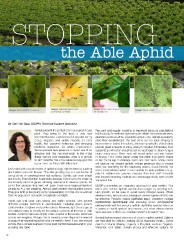
    Image: Black aphids on sedum  Image: Oleander aphid with                     Image: Small aphid colony  Image: Sooty mold
                                  prominent cornicles                            on calibrachoa

By Tami Van Gaal, GGSPro Technical Support Specialist

                             Aphids present the perfect storm as a greenhouse    Frequent and regular scouting is important because populations
                             pest. They bring to the table a very high           build quickly. Sometimes signs are quite visible: the aphids are seen,
                             reproductive rate, a preference for popular spring  distortion exists or white, cast skins accumulate. Aphids repeatedly
                             crops, negative and visible impacts on plant        shed their exoskeletons; the cast skins can be seen clinging to
                             health, low customer tolerance and emerging         leaves near or below the colony, decreasing salability. Aphids also
                             pesticide resistance. An added predicament:         excrete great amounts of shiny, sticky honeydew. Honeydew then
                             Some growers face pressure to avoid use of an       supports growth of an unsightly, but non-pathogenic, black fungus
                             effective tool, the neonicotinoids. In the midst    called sooty mold. Beat tests will reveal aphid colonies hidden
                             these barriers and obstacles, what is a grower      in foliage. Hold white paper under the plant and gently shake
                             to do? GGSPro has a few ideas to help gain the      or tap the foliage to dislodge pests and cast skins. Sticky cards
                             upper hand on this prolific little beast.           will capture the winged aphids, whose presence should always
                                                                                 send you searching for the exploding colony. Scout historic hot
Let’s start with a quick review of aphid biology. Aphids feed by sucking         spots and preferred aphid crops carefully for early problems (e.g.,
plant juices from soft tissues. They like growing tips, but can be found         petunia, calibrachoa, gerbera, pepper). Also train staff to isolate
along stems or covering lower leaf surfaces. Aphids can even attack              and inspect incoming material and encourage sharp eyes on the
plant roots. Reproduction is generally asexual. This means the offspring         transplant line.
share nearly identical genes, allowing resistance to develop quickly. An
aphid that escapes treatment will pass those advantageous/resistant              GGSPro promotes an integrated approach to pest control. This
gene(s) to ALL her offspring. Aphids pack another reproductive punch:            starts with culture. Aphids can be discouraged by avoiding soft,
They give birth to live young carrying developing nymphs. It’s no wonder         lush growth, so be sure to avoid luxury nitrogen levels. When
that the population can seem to explode overnight.                               released early and properly, biological control agents (BCAs) can
                                                                                 be effective. Parasitic wasps (Aphidius spp.), predatory midges
Aphid size and color vary across and within species, with several                (Aphidoletes aphidimyza) and lacewing larvae (Chrysoperla
different species common in greenhouses, including green peach,                  carnea) work well in managing aphids. Aphidius species selection
cotton/melon, foxglove and potato aphids. However, aphids as a group             is based on aphid species and season, and other release details
are relatively easy to identify by the unique cornicles at the rear of their     favor success in BCA use. Contact GGSPro to learn more.
bodies. Aphid nymphs are simply small versions of the adults, and most
aphids are wingless. Winged forms develop when dispersal is needed               Several factors impact chemistry choices for aphid control. Options
to support an expanding aphid colony’s need for food. If you see winged          are restricted for edibles, making BCAs especially helpful. Some
aphids, the outbreak is ahead of your pest control measures and/or your          drench products offering longevity in the plant, such as Flagship,
scouting has failed.                                                             Marathon and Safari, remain strong and effective options for

16

