Dipping unrooted and rooted cuttings has been shown to be an effective method for reducing pest pressures deep into the season. The end result is lower chemical use over the course of the crop cycle. Preventative dipping is a relatively new practice for many ornamental growers, but it is not a new technique.
The research demonstrating the efficacy of dip treatments goes back nearly four decades, when noted entomologist Lance Osborne published research on dipping tropical foliage in a synthetic pyrethroid1. In 2016, Rose Buitenhuis and others showed the utility of dips for whiteflies on poinsettias2. In 2017, the risk of possible disease transmission during dipping was shown to be a low probability. Most recently, researchers in Florida demonstrated the efficacy of several dipping solutions to dislodge the invasive Thrips parvispinus3. These and other studies, published and unpublished, have led the way to widespread adoption. The push for softer chemicals and Integrated Pest Management (IPM) programs has further promoted dip applications to the top of our list of preventative pest control methods. Another factor is that the development and approval of new insecticidal modes of action has slowed to a crawl. Insect resistance is a primary concern for our industry without new chemical options to integrate into rotation.
IPM techniques begin with prevention. Dip applications are a very good way to eliminate or reduce the pests brought into your greenhouse, and that is the best prevention. Similar to sanitation strategies, starting with clean material helps us stay clean throughout production. Product manufacturers have been adapting to the IPM movement and adding a dip application to more product labels. While label changes can take considerable time, 2ee labels can help bridge the gap. Note that 2ee labels are for specific pests, application methods, and/or states or areas, so they may not extend legal usage to all growers’ needs, as is noted below in Table 1.
Table 1: Insecticides for Dip Applications
| Product | Active Ingredients | Major Pests | OMRI | REI (hr) | Item#/ Size |
| BotaniGard ES | Beauveria bassiana strain GHA | Aphids, Mealybug, Mites, Thrips, Whiteflies | Yes | 4 | 70-12511 1 gal |
| BotaniGard WP | Beauveria bassiana strain GHA | Aphids, Mealybug, Mites, Thrips, Whiteflies | Yes | 4 | 70-12521 1 lb |
| Epishield O | Peppermint oil & Clove oil | Aphids, Mealybug, Mites, Thrips, Whiteflies | Yes | 0 | 70-1547 2.5 gal |
| Hexygon IQ* | Hexythiazox | Spider mites | No | 12 | 70-1868 1 qt |
| LalGuard M52 OD | Metarhizium brunneum strain F52 | Aphids, Mites, Thrips, Whiteflies | No | 4 | 70-2291 1 L |
| M-Pede** | Potassium salts of fatty acids | Aphids, Mites, Whitefly | Yes | 12 | 75-10262 2.5 gal |
| Principle WP | Beauveria bassiana strain BW149 | Aphids, Mealybug, Mites, Thrips, Whiteflies | Yes | 4 | 70-2645 1 lb |
| Romivex DIP | Rosemary oil | Mites and Soft-bodied insects | Yes | 0 | 70-2860 1 gal |
| SuffOil-X*** | Mineral oil | Aphids, Mealybug, Mites, Thrips, Whiteflies | Yes | 4 | 70-4040 2.5 gal |
| TetraCURB MAX | Castor oil, Rosemary oil, Clove oil, Peppermint oil | Mites and Soft-bodied insects | Yes | 0 | 70-3125 1 gal |
| Velifer | Beauveria bassiana strain PPRI 5339 | Aphids, Mealybug, Mites, Thrips, Whiteflies | No | 12 | 70-9540 1 qt |
**M-Pede 2ee label allows dipping in all states EXCEPT: NY, AK, MO, TX
***SuffOil-X 2ee labels allows dipping for Thrips parvispinus in FL, GA, NC, NM, SC only
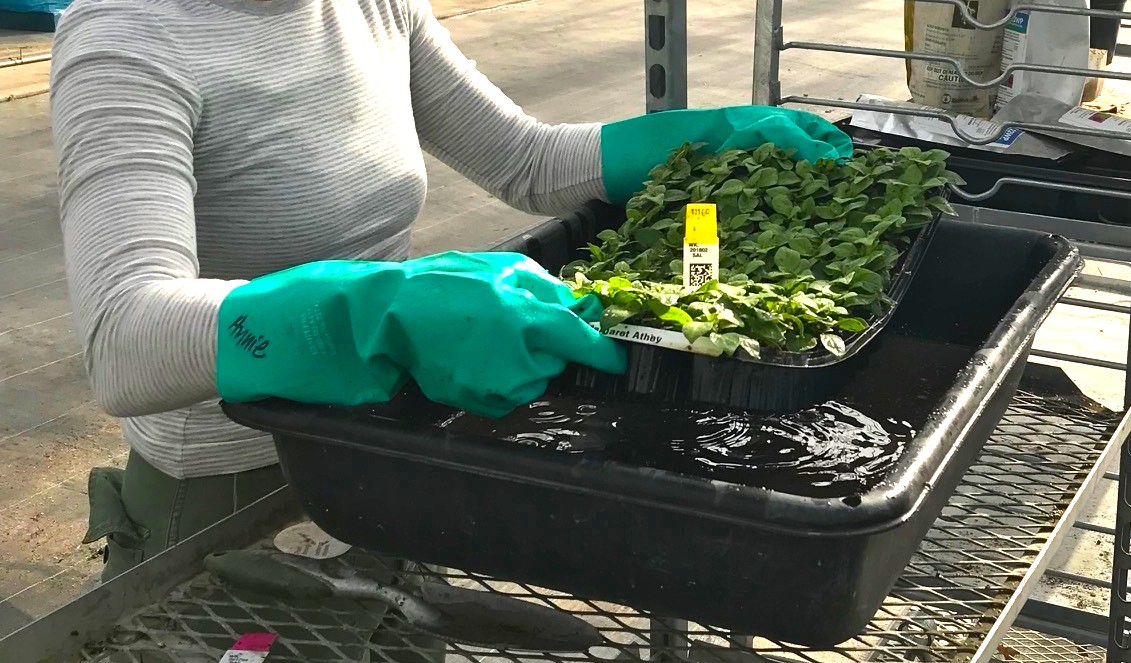
Each of the products listed below provides directions for dipping URC, rooted cuttings, or other transplant material in some cases. Along with recommended submersion time, most labels include post-dip directions for draining, drying, or planting wet. For your preview, those are noted in Table 2. Please read the full label to ensure a product meets your specific needs. Restricted Entry Intervals (REIs) still apply to these products/application methods. Workers handling the plants during the REI need the proper Personal Protective Equipment (PPE) specified by the label. Typical requirements are long sleeves, pants, shoes with socks, and gloves. Some labels require protective eyewear (which is always a good idea to wear). Hexygon IQ additionally requires coveralls during the 12 hr REI. Note that the 25(b) oil-based products EpiShield O, Romivex DIP, and TetraCURB MAX have no REI and list PPE in the label section ‘Precautionary Statements’. Photos and videos of the dipping process are available online to help set up a dipping station or contact us at ggsprotech@griffinmail.com for additional information.
Table 2: Application Rates for Dipping
| Product | Dipping Rate | Use Notes |
| BotaniGard ES | ½-1 fl oz per gal | URC: Dry before sticking. Rooted: Dip top only; can plant wet, dry before watering. |
| BotaniGard WP | ¼-1/2 oz per gal | URC: Dry before sticking. Rooted: Dip top only; can plant wet, dry before watering. |
| Epishield O | ½ tsp per gal | Dip URC or above ground parts of Rooted plants for 10-30 sec while moving plants in solution. |
| Hexygon IQ* | 0.08 fl oz/gal | Immerse bulbs or URC, remove and allow to drain. Do not rinse. |
| LalGuard M52 OD | ½-1 fl oz/gal | URC and Rooted: Wet all plant parts to be treated, allow foliage to dry before planting or watering. |
| M-Pede** | 0.31 – 0.63 fl oz per gal | Transplants, URC: If tank mixing with another product, use 0.63 oz/gal. |
| Principle WP | 0.25-0.5 fl oz per gal | URC: Dry before sticking. Rooted: Dip top only; can plant wet, dry before watering. |
| Romivex DIP | 0.32-0.64 fl oz per gal | URC: Submerge 15-60 sec. with gentle agitation. Wet all leaf surfaces, drain and plant. |
| SuffOil-X*** | 0.75 tsp per gal | URC, Rooted, Transplants: Dip 5-10 sec to ensure all leaf surfaces are wet. Do not dip rootballs. Allow to dry before watering, shade treated URCs. |
| TetraCURB MAX | 0.32 fl oz per gal | URC: Submerge 30-120 sec. with agitation, allow to drain. |
| Velifer | 0.7-0.13 fl oz per gal | URC and Rooted cuttings: Wet all surfaces. Allow to dry completely before sticking or watering. |
**M-Pede 2ee label allows dipping in all states EXCEPT: NY, AK, MO, TX
***SuffOil-X 2ee labels allows dipping for Thrips parvispinus in FL, GA, NC, NM, SC only
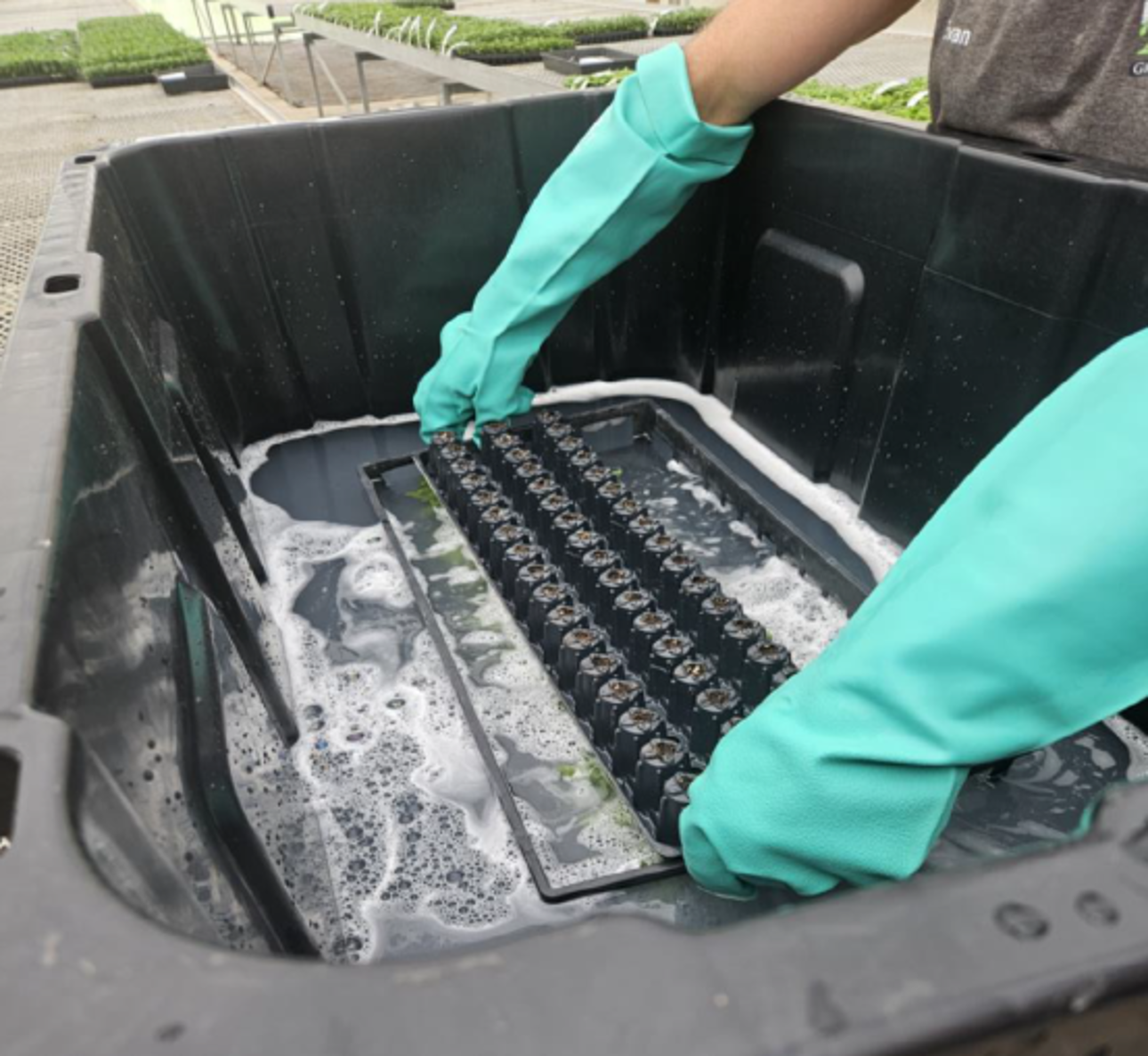
The dipping method is a valuable tool in our fight to start with young plants. The downside is that phytotoxicity is a real possibility that must be tested across the range of crops we grow in the greenhouse. Note that the concentration for dipping solutions is often significantly lower than for spray solutions. Growers must trial a small number of plants of each crop, adhering to the requirements and recommendations of the product label. Phytotoxicity (“phyto”) will generally appear in 1-4 days if the foliage is damaged. Material that has been put under stress while stored or handled poorly increases the chances of phyto when being dipped. Additionally, inhibition of rooting is possible with some genera and specific products when dipping URCs.
Trialing products is always a prudent step for growers to find a solution that works for their crops, timing, and conditions. Optimizing a dipping process through experimentation will pay off in the end with reduced chemical use, fewer spray labor hours spent, and healthier crops.
- Journal of Economic Entomology, Volume 79, Issue 2, 1 April 1986, Pages 465–470, https://doi.org/10.1093/jee/79.2.465
- Insects 7, no. 4: 48, https://doi.org/10.3390/insects7040048
- Journal of Economic Entomology, Volume 118, Issue 2, April 2025, Pages 780–786, https://doi.org/10.1093/jee/toae265